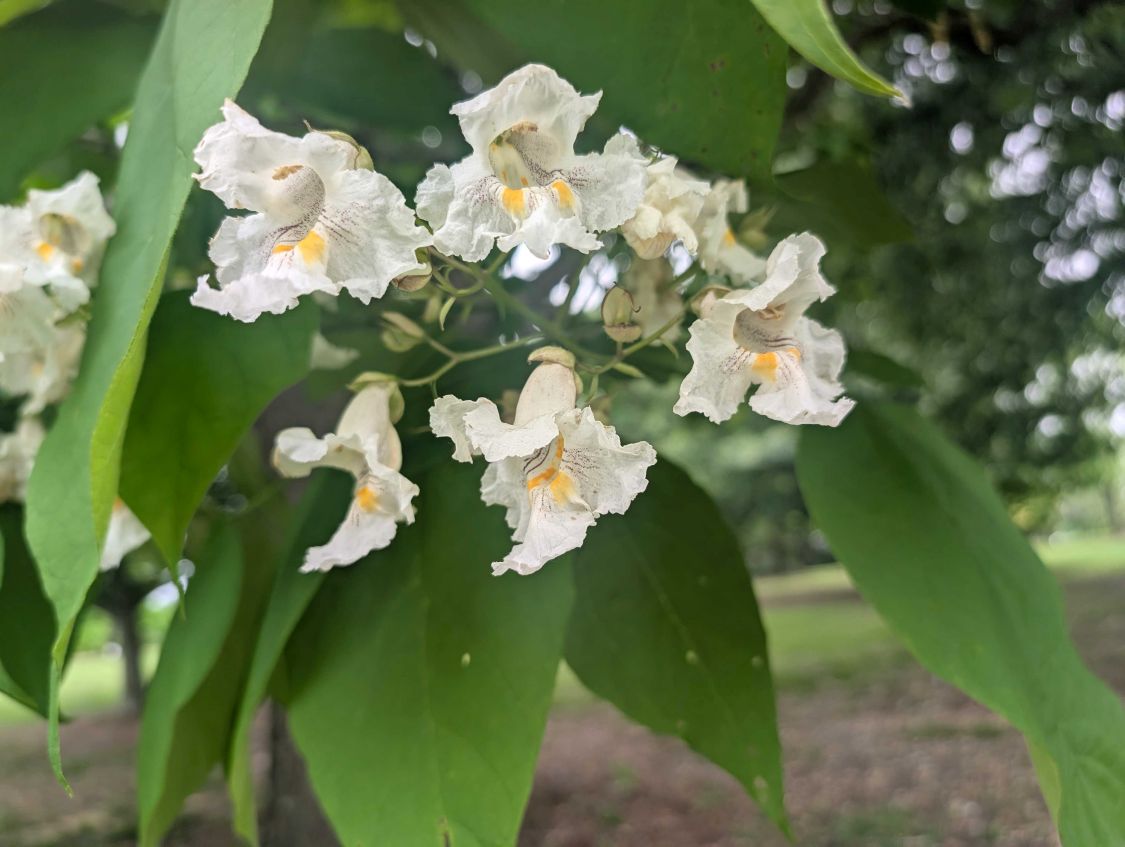
UT Gardens’ May Plant of the Month
Submitted by James Newburn, Managing Director, UT Gardens, Knoxville
As a child, I remember looking at our May Plant of the Month and wondering if it was where string beans came from. My dad always called it a cigartree because he and his buddies pretended the seed pods were cigars. The tree in question is our native Catalpa, one of the most unique and beloved large ornamental trees in the south.
There are two species of catalpa native to North America. C. bignonioides, or southern catalpa, was originally found in the southeastern U.S., and C. speciosa, or northern catalpa, is prevalent in the Midwest up to New England. The appearance of the two is similar, with the northern variety having slightly larger flowers and leaves and hardier for northern zones. Both species have been planted as ornamental specimens in parks, estate homes and arboreta for years, and there are now many naturally occurring hybrids.
What an ornament it is, too! Catalpas have a very striking appearance. The southern catalpa can reach up to 30-40 feet with a large trunk reaching up to 3 feet in diameter on a mature specimen. They have a general oval shape but often have twisted and uneven canopy, giving them a very sculptural structure in winter. The heart-shaped leaves emerge bright green in spring and can reach 8-12 inches in length, making for good shelter from rain and sun for insects and birds. The flowers are gorgeous, mostly white with specks of yellow and purple and tubular shaped like other flowers in the bignonioides, or trumpet vine family. The flowers grow in panicles, or flower clusters, of up to 20-40 individuals that can almost hide all the leaves. These clusters are almost orchid-like and are one of the most beautiful of our native flowering trees.
Catalpas are not picky at all when it comes to requirements. They do need full-sun and room to grow because of its size. A relatively fast grower, they can tolerate most types of soil and can weather drought conditions reasonably well once established. It is slow to leaf out in spring and flowers in late spring through early summer when many ornamental trees are past their flowering stage. The 6-to-15-inch-long fruit is a capsule that holds the seed. This where the common name of “Indian bean tree” derives. As the seed pods mature and ripen, they split open and release the seed. The dried capsules fall off the tree as well as the leaves during autumn.
The name catalpa comes from the Muscogee name “kultuhlpa” and is important environmentally. It is the only food source for the catalpa sphinx moth, whose caterpillars feed on the leaves. A heavy infestation can defoliate a tree, but it quickly responds by sprouting new leaves. These caterpillars are known for being excellent live bait for fishing. Many dedicated fishermen will plant a catalpa to harvest the caterpillars and use them for bait.
This beauty of a tree is familiar to many people who recognize the tree but are not sure what it is called. We have southern catalpas at the UT Gardens in Jackson and Knoxville, but one may encounter them in parks, roadways or in the wild.
The UT Gardens includes plant collections located in Knoxville, Crossville and Jackson, Tennessee. Designated as the official botanical garden for the State of Tennessee, the UT Gardens are part of the UT Institute of Agriculture. The Gardens’ mission is to foster appreciation, education and stewardship of plants through garden displays, educational programs and research trials. The Gardens are open during all seasons and free to the public.